

Thermocouple Reference Junctions
Thermocouples are commonly used temperature sensors in industry. The Seebeck effect is utilized for temperature measurement with a thermocouple.
Thomas Johann Seebeck accidentally discovered that an electrical voltage is generated between two ends of a metal rod if there is a temperature difference (temperature gradient) within the rod. After connecting both ends, an electrical current flowed, the magnetic field of which he detected with a compass needle. In 1821, Thomas Johann Seebeck succeeded in utilizing this effect in an early thermocouple.
The Seebeck effect generates an electrical voltage between two points of an electrical conductor that have different temperatures. To measure the electrical voltage of a thermocouple, the thermocouple cable is connected to a universal measuring device. The connection material in measuring devices usually consists of copper. This means it is a different material than that of the thermocouple. When connecting the thermocouple to the measuring device, two new thermocouples are created!
The use of a reference junction prevents errors in measurement results.

Typically, the temperature of the transition point from thermowire to extension wire is measured and electrically compensated as a reference junction. The knowledge of the reference junction temperature is a factor in the accuracy of thermocouple temperature measurement.
Thermocouples always measure a comparison between a “hot” and a “cold” measuring point. If the “cold” measuring point is always kept at a known, stable temperature (e.g., 0 °C), this directly contributes to the precision of the temperature measurement. A calibrated Pt100 temperature sensor monitors the reference junction temperature.
This reference junction is also called cold junction compensation, CJC, thermocouple reference junction, reference junction compensation, or ice point thermostat.
Pre-fabricated Reference Junctions

(Recommended only for Type T thermocouples)

Find Your Suitable Thermocouple Reference Junction
The TRU 938 ice point thermostat provides a stable and accurate 0 °C (or an elevated) reference temperature. It is a self-contained unit with Peltier technology, enabling maintenance-free operation.
Advantages of the Ice Point Thermostat:
suitable for laboratory use
high capacity
suitable for high ambient temperatures
(up to 65 °C)
robust design

The TRU 937 ice point thermostat provides stable and accurate 0 °C or an elevated reference temperature between 45 °C and 70 °C.
Advantages of the Equipped Ice Point Thermostat:
for up to 100 reference junctions
compact design
desired reference temperature adjustable
number and type of thermocouples for equipping selectable
Connection via Klippon terminals or according to customer requirements (e.g., mini plugs)
for use in high ambient temperatures
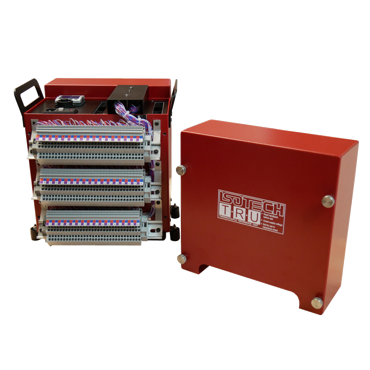
The TRUrac is a thermocouple reference system for 0 °C or elevated temperatures, mounted in a 19″ housing. It was developed for situations where the ambient temperature can be up to 65 °C.
Advantages of the Ice Point Thermostat for Control Cabinets:
Mounted rack: 19″ chassis with integrated TRU 937 ice point thermostat
for installation in control cabinets
high capacity up to 200 double reference junctions
Connection via Klippon screw terminals or according to customer requirements
standardized chassis fits into commercially available control cabinets
proven in power plants

The Hotbox is housed in a robust, waterproof IP66 enclosure and features a base plate.
Advantages of the Reference Junction:
predefined reference temperature between 45 °C and 70 °C
for use in very high ambient temperatures (max. 50 °C) and harsh environments
stability 0.05 °C
splash-proof housing
high capacity – up to 200 reference junctions
proven in power plants

Advantages of the Reference Junction:
effective temperature 0 °C
for use in ambient temperatures between -20 °C and 70 °C
stability 0.05 °C
splash-proof housing (IP669 protection class)
up to 100 reference junctions
proven in power plants
