
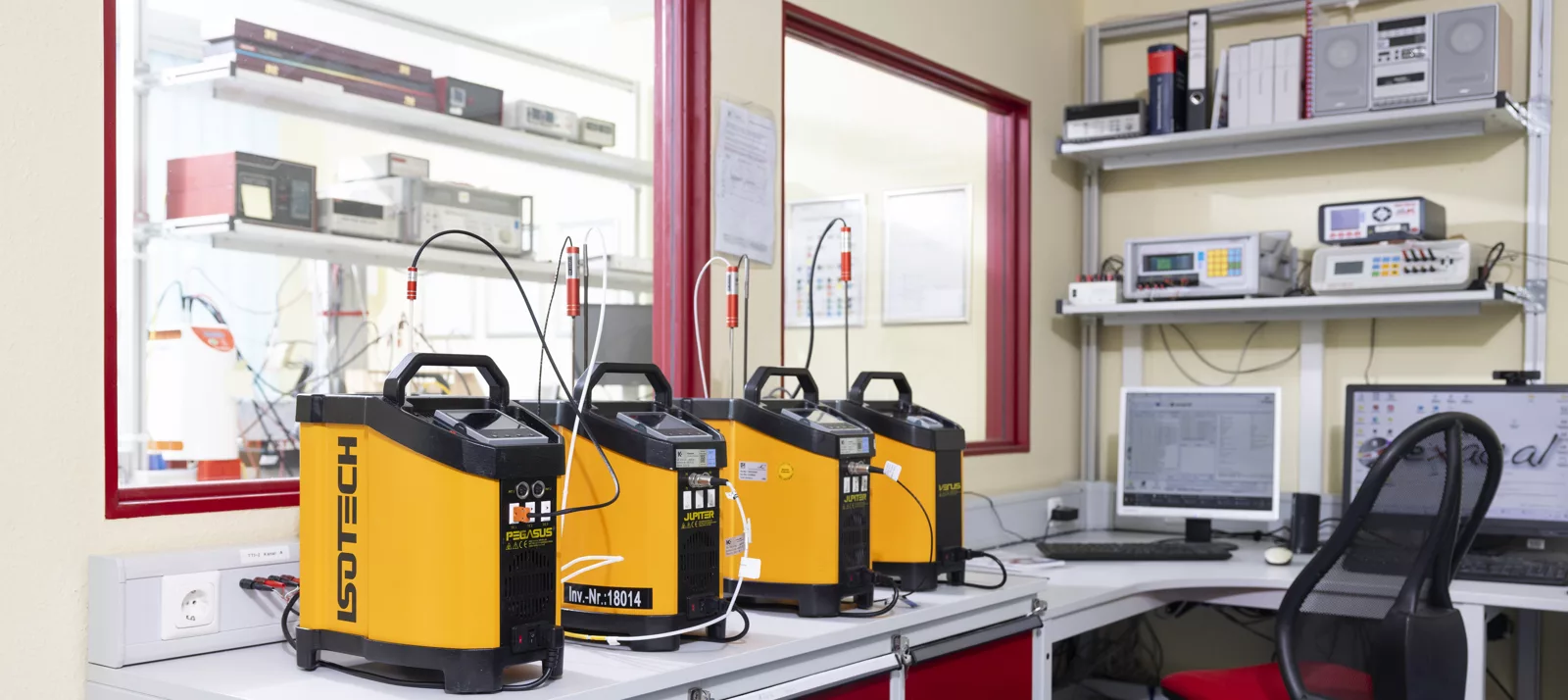
Reliable measured values for your temperature dry block calibrator
Your temperature dry block calibrators are only as reliable as their last calibration.
With our DAkkS-accredited calibration in accordance with DIN EN ISO/IEC 17025, you receive measurement results that are traceable and fully documented.
This provides a solid basis for your quality assurance and saves you discussions in the next audit.

Low measurement uncertainties
In the accredited range, measurement uncertainties are between 0.08 K and 6.0 K, depending on the temperature range.
Fast turnaround times
Calibration within 5 working days for minimal downtime.
Standards-compliant calibration
In the accredited range according to DIN EN ISO/IEC 17025 (DAkkS) based on DKD-R 5-4
(I-CAL-GUI-013).
Price overview

Standard package with 5 calibration points
€980.00
SKU: KK-1440
Scope of services:
- Accredited calibration according to DIN EN ISO/IEC 17025 (DAkkS) at 5 calibration points, in standard distribution or according to your specifications.
- Calibration certificate with documented calibration results as well as information on measurement deviation and measurement uncertainty.
- For ISOTECH devices, controller adjustment is possible after technical inspection and your approval.
Alternative: Individual calibration points
SKU: KK-1442 (basic costs) + KK-1443 (per calibration point)
If you need an individual number of calibration points, we calculate modularly. The costs are made up as follows:
- Basic costs: €505.00
- Per calibration point: + €100.00
Calibration according to this model is possible from 3 calibration points.
The scope of services corresponds to the standard package; the number of calibration points is defined individually.
Note: All prices are ex works Fulda, plus VAT, postage, packaging and transport insurance.
Accredited measurement ranges and extensions according to scope of accreditation
| Measuring range | Measurement Uncertainty | Comparison with |
|---|---|---|
| -40°C to < 0°C | 0.1 K | Standard resistance thermometers |
| 0°C to 100°C | 80 mK | Standard resistance thermometers |
| > 100°C to 130°C | 0.1 K | Standard resistance thermometers |
| > 130°C to 200°C | 0.3 K | Standard resistance thermometers |
| > 200°C to 400°C | 0.5 K | Standard resistance thermometers |
| > 400°C to 660°C | 1.0 K | Standard resistance thermometers |
| 0°C to 660°C | 1.5 K | Standard thermocouples |
| > 660°C to 800°C | 2.5 K | Standard thermocouples |
| > 800°C to 1000°C | 4.0 K | Standard thermocouples |
| > 1000°C to 1200°C | 5.0 K | Standard thermocouples |
| > 1200°C to 1300°C | 6.0 K | Standard thermocouples |

Technical requirements for calibration according to DKD-R 5-4
For standards-compliant calibration, the technical requirements defined in DKD-R 5-4 must be met.
Immersion depth: The immersion depth of the thermometer must be at least 15 times its outer diameter.
Bore and thermal contact: The bore in the calibration insert must match the thermometer: up to 660°C, the inner diameter may be max. 0.5 mm larger than the outer diameter of the thermometer, and above 660°C max. 1.0 mm larger. Alternatively, equally good or better thermal contact can be achieved using suitable heat transfer media.
Measuring zone: The temperature dry block calibrator must have a specified measuring zone of at least 40 mm in length with sufficient temperature homogeneity.
Get in touch. We will check your device and find a suitable solution.
Gemeinsam die richtige Lösung für Sie finden

Speak directly with our expert!
Your contact for calibration services
and proficiency testing:
Boris Kalb
The calibration process: Transparent, structured, standards-compliant
Calibration in our laboratory takes 5 working days.
- Step 1: Goods receipt and device acceptance
As soon as your device arrives, we unpack it and check it for visible defects or transport damage. If we notice anything, we will contact you before taking any further steps. We then register your dry block calibrator in our system under a calibration number. - Step 2: Preparation in the calibration laboratory
Before we start calibration, we check the conditions in the laboratory. Then we set up the dry block calibrator, connect it and insert the reference thermometer into the block. - Step 3: Performing the calibration
We connect the reference thermometer and record the measured values—depending on the device, via software or manually. We approach the target temperatures first in ascending order and then in descending order to determine the hysteresis error. - Step 4: Evaluation, measurement uncertainty and calibration certificate
The measured values are evaluated and the measurement uncertainty is calculated according to EA-4/02 M. We prepare the uncertainty budget in accordance with DKD-R 5-4 and record the results in the calibration certificate. - Step 5: Follow-up and return shipment
After calibration, we label your device and attach a calibration label with a QR code. Using this code, you can access your calibration documents at any time in the Klasmeier Cloud. We then pack the dry block calibrator securely and send it back to you.

Klasmeier Cloud Digital Archive:
Calibration documents accessible quickly and easily
The Klasmeier Cloud – the perfect filing system for all calibration documents. On all devices calibrated by Klasmeier, you will find a QR code that takes you quickly and easily to our digital archive.
Especially practical: In addition to all calibration documents, you will always find the contact details of the respective contact person at Klasmeier there as well. This way, even in five or more years, you can find the information you need with one click if you have any questions about your calibration product.
Frequently asked questions about the calibration of dry block calibrators (FAQ):
What information do you need for a quotation?
For a quotation, we only need your company details. You are also welcome to tell us the desired calibration points, the model designation and the serial number of your dry block calibrator—otherwise we will prepare the quotation based on our standard package.
What happens if my device does not fully meet the technical requirements?
Just get in touch and we will find a suitable solution together!
What do I need to send in for calibration?
Please always send the dry block calibrator together with the inserts used, the temperature probe and the appropriate power cable.
Pack the device securely for transport. Temperature dry block calibrators are sensitive devices and should be transported upright.
Can I bring my dry block calibrator in person?
Yes, you are welcome to drop off your device in person during our goods acceptance hours.
Goods acceptance hours:
Monday to Thursday: 9:00 AM to 4:30 PM
Friday: 9:00 AM to 1:00 PM
How does the return shipment work and is it insured?
After calibration, we return your device via our transport insurance and charge you the insurance costs.
Alternatively, you can also organise the return shipment and insurance yourself.
Is there a simplified calibration for smaller devices or QuickCal?
The calibration scope is defined independently of device size or product designation.
Calibration is carried out in accordance with the scope of accreditation, standards-compliant and traceable.
What happens if adjustment, controller optimisation or repair is necessary?
As part of calibration, we document the current condition of your dry block calibrator. If we determine a deviation outside the manufacturer specification, we will discuss the next steps with you.
For ISOTECH devices, this may mean an adjustment of the controller or the display system—we will also coordinate this with you in advance.
We only carry out repairs after your approval. Depending on the device, we will check whether we can carry out the repair in-house.
Will I also receive the calibration certificate printed out or in English?
The calibration certificate is provided digitally as standard.
On request, we can also issue the calibration certificate in printed form.
Issuance in English is also possible. Please contact us if required.
Which standards and guidelines are relevant for calibration?
Our DAkkS accreditation is based on DIN EN ISO/IEC 17025. DAkkS-accredited calibration of temperature dry block calibrators is carried out according to DKD-R 5-4.
In the European context, the guideline EURAMET Calibration Guide No. 13 is also used for the calibration of temperature dry block calibrators, known as EURAMET cg-13 or I-CAL-GUI-013. For our accredited calibrations, DKD-R 5-4 is decisive.
International recognition of accredited results is supported by recognition agreements such as EA MLA (Europe) and ILAC MRA (international).