

Online Seminar: Measurement Uncertainties in Temperature
What You Will Learn in This Seminar
Learn how to calculate measurement uncertainties in the field of temperature measurement and temperature calibration in this seminar.
We will show you how to meet all requirements according to (GUM) and the current DKD/DAkkS/EA guidelines. We will also discuss typical errors and how you can avoid them. Through the technical knowledge provided and the sample calculations in the practical section, you will gain confidence in creating your measurement uncertainty budgets. This way, you never have to feel again that something went wrong with your calculations or that you forgot something important.
Seminar Benefits
Comprehensive Seminar
In four theoretical and four practical modules each, we provide you with all the essential content. You will receive case study assignments and can apply what you have learned directly. We then discuss the results in the group.
Virtual Conference
In our seminar, you can actively participate. You can ask questions at any time and exchange experiences with others. We set up a virtual conference room for this purpose. It is therefore not a webinar where it is only about listening.
Klasmeier Connect
With group chat and direct messaging, you can exchange ideas with participants and speakers, watch videos, and download PDFs in the KlasmeierConnect Community.
Access remains available after the seminar.
Dates
Theoretical Part
11/03/2026, 11/05/2026, 11/10/2026, 11/12/2026
Tuesdays and Thursdays
10:00 AM to 11:00 AM
Practical Part
11/19/2026, 11/26/2026,
12/03/2026, 12/10/2026
Thursdays
10:00 AM to 11:00 AM
Price: €1,590
Registration Deadline: 10/20/2026
How the Online Seminar Works
Program Schedule: Theoretical Part
We have divided the seminar into a theoretical and a practical part. You can directly apply the knowledge gained in the theoretical part in the practical part. You will create practical measurement uncertainty budgets within the framework of case studies for various calibration tasks. These comply with the valid DAkkS guidelines and you can use them as templates for your own measurement uncertainty budgets.
The content of the theoretical part is distributed over four consecutive modules. Each module lasts approx. 60 minutes.
And don’t worry if you can’t be there live on one of the dates: We record all modules for you and make them available to you afterwards in the KlasmeierConnect Community .
Module 1 – Fundamental Theory for Creating Measurement Uncertainty Budgets in Temperature
Fundamentals of probability theory and statistics
Measurement uncertainty according to GUM, DKD, and EA guidelines
Estimated value, distribution, and probability
Model equation
Measurement uncertainty budget
Module 2 – Measurement Uncertainty Components for the Measurement Uncertainty Budget – Temperature Representation
Reference junction
Inhomogeneity
Axial and radial temperature distribution
Temporal temperature distribution
Fixed-point temperature
Module 3 – Measurement Uncertainty Components for the Measurement Uncertainty Budget – Thermometers
Sensitivity
Thermometer drift
Self-heating
Standard Platinum Resistance Thermometer (SPRT) vs. Reference Thermometer
Module 4 – Measurement Uncertainty Components for the Measurement Uncertainty Budget – Data Acquisition
Evaluation unit
Resolution
Scanner / Multiplexer
Measurement bridge
Drift of the measurement bridge
Program Schedule: Practical Part
The practical seminar is distributed over four modules. Each module lasts 60 minutes. In each module, tasks are discussed and explained using case studies. Between the individual modules, you can work on the tasks and expand your skills. In the following modules, we discuss the work results in the group.
Throughout the entire time, you can use the Klasmeier.Connect Community for communication, data exchange, and collaborative work on documents. With the chat system, you can also communicate with other seminar participants and the speakers during the practice time between modules.
The content of the practical part is based on the guidelines “DKD-R 5-3 Calibration of Thermocouples” and “DKD-R 5-1 Calibration of Resistance Thermometers.” This allows you to use the documents, exercises, and work results afterwards as templates for your own measurement uncertainty budgets.
Your Speakers
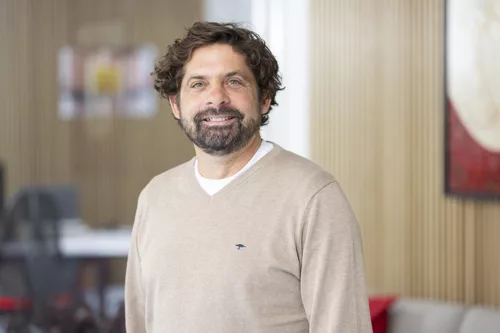
Thomas Klasmeier
Dipl.-Ing. (FH)
Thomas Klasmeier is the managing partner of the medium-sized company Klasmeier, based in Fulda. The company specializes in temperature measurement and temperature calibration, operates the DAkkS-accredited calibration service Klasmeier, and produces eXacal precision thermometers.
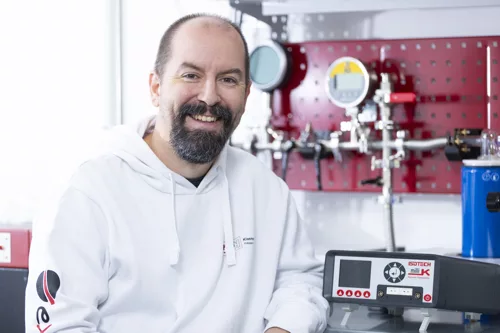
Boris Kalb
State-Certified Technician
Boris Kalb is the head of the Klasmeier calibration laboratory and is responsible for day-to-day operations in the temperature laboratory. He has gained over 20 years of professional experience at Klasmeier. As head of the calibration body, he regularly participates in the technical committee meetings of the DKD.

Optimally Networked with Klasmeier Connect
Stay connected in the community after the online seminar
All seminar participants receive access to our Klasmeier Connect Community.
With group chat and direct messaging, participants can exchange ideas with other participants and speakers before, during, and after the seminar, watch recordings, and download PDFs. Access remains available even after the seminar.